|
INSPYRE –
INjected
Smoke
and
PYRocumulonimbus
Experiment
|
|
|
|
|
Project Overview
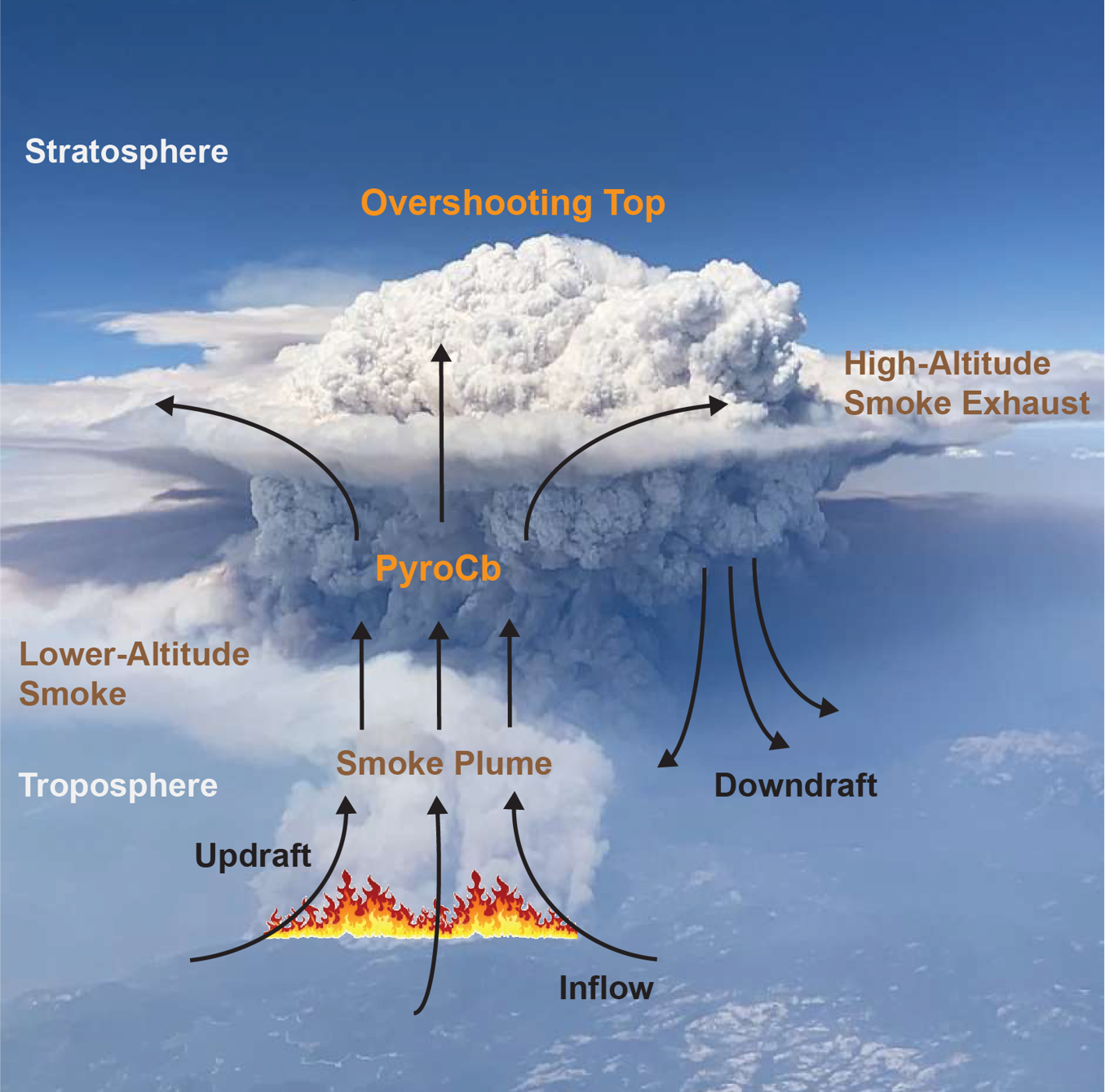
The INjected Smoke and PYRocumulonimbus Experiment (INSPYRE) Science Team will constrain the role of pyrocumulonimbus (pyroCb) in the earth system and characterize their physical links to extreme wildfire behavior.
|
Increasing wildfire size and intensity will amplify pyroCb-driven smoke injection into the stratosphere and induce measurable changes to Earth's radiative balance.
To test this hypothesis, we will employ NASA's ER-2 and NSF/NCAR's GV airborne platforms, along with ground-based platforms to obtain the remotely sensed and in situ measurements required to quantify the processes leading to pyroCb development, the downstream consequences of pyroCb-injected smoke on the upper troposphere and lower stratosphere (UTLS), and feedbacks between pyroCbs and extreme fire behavior. Observations will span the full spectrum of wildfire and pyroconvective activity, ranging from precursor pyrocumulus (pyroCu) to large pyroCbs that inject smoke directly into the stratosphere. The ER-2 payload will include remote sensing instrumentation, while the GV payload will prioritize in situ and radiation instrumentation, with a subset of remote sensing measurements. Ground-based sampling will include scanning active remote sensors and other in-situ measurements.
|
|
|
INSPYRE will test the hypothesis that:
By combining these measurements with satellite observations and modeling, INSPYRE will address three science questions that establish links and feedbacks between the physical processes enabling pyroCb initiation, smoke injection into the UTLS, and downstream consequences:
- Which fires produce pyroCbs and why?
- What mechanisms determine whether a pyroCb will inject smoke directly into the stratosphere, and what will be the magnitude of the ensuing plume?
- How do pyroCb-injected smoke plumes modify UTLS composition and radiation budget?
|
 |
|
|
|